Rest nests and the meaning of art
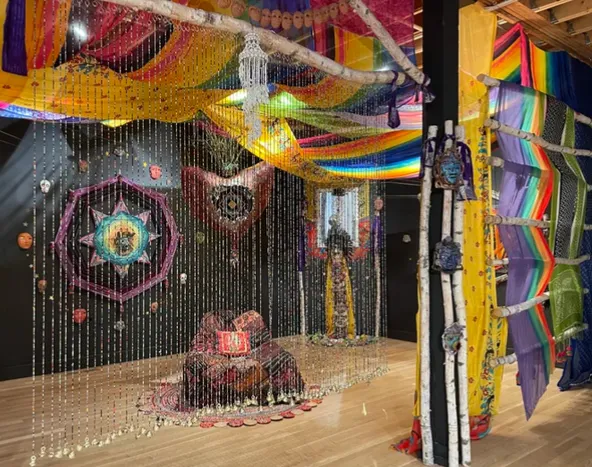
For my last birthday I visited the Boulder Museum of Contemporary Art during an exhibition called "Divine Rest Nests". Per the description, it is an "immersive and liberatory exhibition" about "rest as resistance"1 composed of a series of "nests". That is, each room is set up to be a cozy space of some kind. Viewers were invited to go inside these nests, sit down on the chairs or blankets within, and rest.
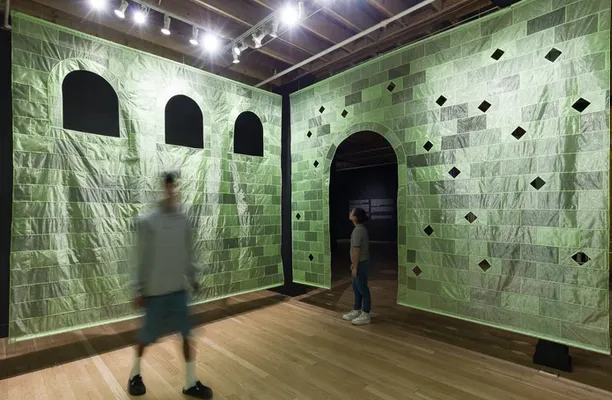
I had two favorites. One of them was a barebones lime-green "castle" — a translucent plastic membrane suspended from the ceiling, which you could lift up and walk through. There's nothing inside the castle; unlike the other works there were no cushions, no decorations, no such niceties. Sounds felt louder, the room felt smaller, the green membrane felt especially poisonous-animal-colored. I felt looked at on all sides through the windows in the "walls". It was not comfortable. And yet I liked this exhibit, because it felt honest. My body has trouble responding to "somatic" anything, so for me most of the other works were just this uncomfortable skeleton with some skin grafted on — smoke and mirrors and beanbag chairs and dream catchers and yogi aphorisms.
That is to say, I'm glad I went, but the exhibition wasn't really for me. The damning realization hit as I was waiting for my sister — I had chosen to rest on a bench looking at a nest, rather than one of the nests specifically made for resting. I realized immediately why this was: The bench was up against the wall, instead of the center of the room. It's basic feng shui that every wall your chair is up against is one fewer direction your monkey brain has to monitor for enemies, and I know my body feels this especially strongly. Thus, I felt submerged in irony. I could go to these exhibits to abstractly celebrate a reified divine rest, but I could not rest in them.
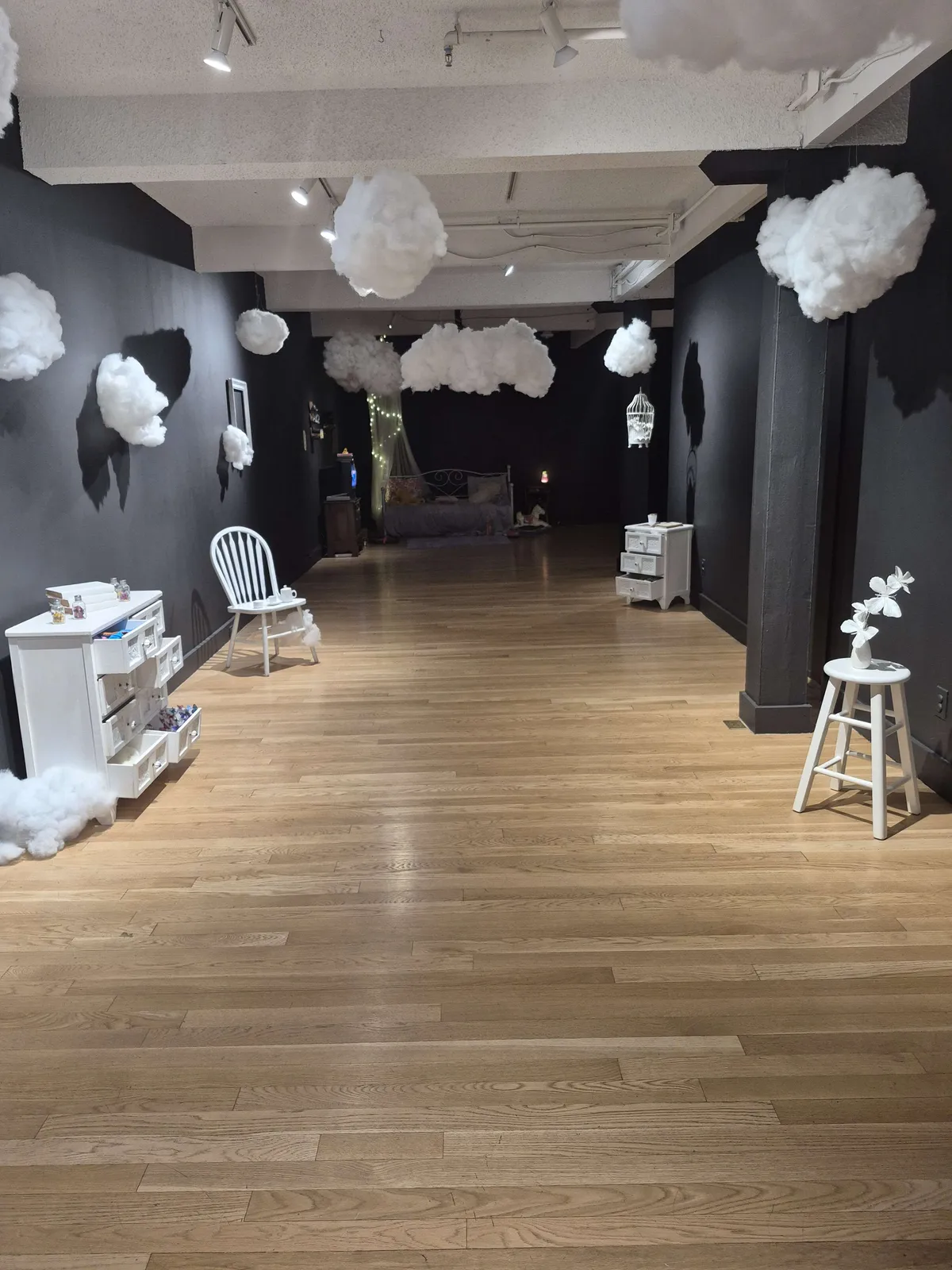
None of this criticism holds for my other favorite exhibition. Cindy Loya's rest nest began with a limen: the hallway leading up to it is decorated with furniture painted white, overflowing with cotton clouds. And beyond this heavenly entryway was a dimly lit space decorated like a teenager's bedroom, including a bed, millenialcore toys, and even a TV with VHS releases of Disney channel originals.
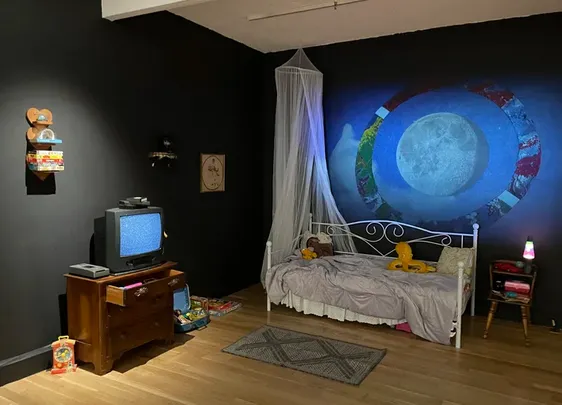
I had a numinous experience. I have a few equally valid explanations for this. Perhaps this evocation of a girl's teenage life filled some girl-puberty-shaped hole in my transgender heart. Perhaps I was having a nice time simply because the bed was in the corner and it was a really beautiful exhibit. Whatever the cause, I was in fact resting, and wondering, and possibly even self-actualizing, and overall having a rare moment of enjoying being an animal with a nervous system.
As I walked out, I took one last look through the hallway I had come through, a strange and picture-perfect ecotone where furniture was halfway between material and ideal, holding its shape but not its color or function. And I became utterly convinced of a single thought:
I have to send an important, embarrassing email I've been procrastinating for months.
...Now, I can't know for sure, but I suspect that's not what the exhibitioners had in mind. Actually, that's a lie — I know it's not what they had in mind, because there's a lot of writing about it:
Intentional community programming will anchor dreams and visions of what is alchemized through rest portals and support this journey of restoration, love, and liberation.
Divine Rest, Nests: An Invitation honors the lineages of those who were denied rest, and uplifts rest as a site of healing, restoration, and collective liberation. Each installation offers a rest nest — an intimate sanctuary where being is enough and where deep rest becomes an act of political and spiritual defiance.
May the nests you encounter awaken something ancestral, tender, and powerful within you. May they remind you that you are beloved.
I'm sure if you were my therapist you would figure out a way to defend my reaction. You might say that sending this stressful email was a precondition for me to rest, or you might point out that working for my own self-actualization would put me in a place to believe that being is enough. But let's be serious: I'm not fulfilling an ancestral, tender urge by resolving to send an email. In fact, "Just one more email, then I can rest" is what a character would say in the first scene of a movie to communicate the lesson they needed to learn. This was not rest-as-defiance; if anything, it was rest-as-compliance. The art did have an undeniable force on me, and it improved my life; that email was a precondition for my graduation. But the direction of that impact was seemingly at random. How would you react to hearing that if you were the artist?
Everyone has an opinion on what abstract thought is for, exactly. Marx's take needs no introduction:
The philosophers have only interpreted the world, in various ways; the point is to change it.2
As an antithesis I propose this: The world changes constantly, in various ways; changing it in ways we prefer requires interpretation. (Marx knew this, of course — that's why he spent his life writing and circulating books about workers' relationship to their labor — but we often forget he did.)
It's easy, as an artist, to try to maximize your art's normative force — that is, to think that you can make something that will circulate the truth so effectively that it will contribute toward immanentizing the eschaton and taking us from the Age of Suffering to the Age of Shepherding. I don't care for this outlook, and it's not for insufficient want of its imagined result. It's just not the worldview you end up with when you work with humility, accept that you aren't the endpoint of history, recognize that your shitty neighbors aren't vermin that can be purified by recognition of truth, and so on.
Here's the conjecture I have instead: Art3 is especially good at surfacing things people already believe or already want to believe — intensifying them, giving them language and shape, making you feel warm fuzzies when they're affirmed. Guernica shocks us because we already know war is horrible; Portrait of Ross feels like watching a life go out because Gonzales-Torres has told us precisely what it means. That's not to say humans can't change or that you can't change them; simply that if you want to change people, don't make art4, make something else: a white paper, a manifesto-zine, a blog post. Or perhaps consider: maybe your goal really is to say something we already know, but could stand to know more intensely, more deeply, more seriously.
You know how if you're describing a Lovecraftian monster beyond comprehension, you shouldn't call it "strange" or "horrifying", you should just describe something strange or horrifying? In the same way, I think calling your own exhibition "liberatory" is cheating.↩
"Theses on Feuerbach", XI. Trans. Brian Baggins. I fell down a small rabbithole recently looking at the original German! As far as I can tell, when Engels edited the eleventh thesis, he added the word aber "however". Here's a transcription of the original, and here's one of the edited version. I feel like that changes the meaning massively — especially given that the German text we translate to "the point is" isn't one-for-one, but idiom-for-idiom. It feels to me like in the original version, the relationship between interpretation and change is temporal or causal, whereas in the edited version it's more of a "virgin interpretation vs. chad change" situation.↩
i.e. a thing viewed through the lens of art↩
i.e. make something that's naturally viewed through another lens↩