The things we do for good citational practice
So it's crunch time on my thesis, and that means I'm doing some writing in the difficult voice of "academically rigorous but also accessible enough to pass as a blog post". You can actually poke around the work in progress here (although since it's a work in progress I make no guarantees about uptime or intelligibility, and fewer guarantees about fun). It's been loads of fun and super educational, but as I'm ping-ponging between Javascript and accessible technical writing it occurs to me that I could've just taken the easy way out and written twenty pages about Keats. Ah, well — the highs are some of the most satisfied I've ever felt in a creative project, and the lows build character.
My story today, though, is about a startlingly non-technical rabbithole. When I was writing the manifesto (read: statement of exigency) I decided to include a haiku that I thought summed up what I was thinking perfectly, at least in the translation I had:
I write, erase, rewrite,
Erase again, and then
A poppy blooms.
This toy I'm building is, in fact, an experience of erasing and rewriting, so I thought it was a lovely fit. I even decided to build a little "double quote" HTML gadget to include both the original Japanese and the English translation. This was perhaps a worse use of my time than implementing some more of the toy itself, but whatever, I think it looks pretty fantastic.
Trying to find the Japanese text of the haiku led to the first red flag. The anglophone Internet, in its decaying spiderweb of content eating itself, was reluctant to give me the original text. Fortunately, by adding "reddit" to my search, I was able to find a thread containing both the original and a translation. The sticking point seems to have been that the entire anglophone Internet (including myself) thought the haiku is by Katsushika Hoku-sai (you know, that Hokusai). The Reddit thread claimed that it was instead the death-poem of Hoku-shi. In an act of unbelievable kindness, u/Zoidboig had linked the Japanese Wikipedia page for Hokushi, and a Ctrl + F for the Japanese text of the poem combined with Google Translate seemed to prove to me that the poem was indeed by Hokushi. That's a little embarrassing for me, but after I reframe my feelings as gratitude for the privilege to be wrong safely and harmlessly, I conclude I should have everything I need. So, I finished the manifesto and went to bed.
Today, though, as I was revising the manifesto, I realized that I had forgotten to actually put the citation of the poem. It goes without saying that citing "Kubla Khan" but not the poppy haiku would be a silly mistake to make on an honors thesis even if it weren't low-key Orientalism. I added the footnote tag to my code1 and put in the name of the poet, the translator...
...wait, I don't know who translated this haiku or where they published it, do I?
Not a problem. There's not an English Wikipedia page, but there is a Japanese one. And the part where the full haiku appears has two sources— oh, right, they're both entirely in Japanese. I spent a fair bit of time trying to symbol-match to confirm the haiku was on the page before realizing that even if I found what I was looking for, it wouldn't give me the translator.
What's frustrating about this is that the translation I'm looking for is everywhere. Here are some of the pages I passed by on my quest:
- An SEO blog crediting the poem to Hokusai.
- Another SEO blog crediting the poem to Hokusai.
- A poetry aggregation site crediting the poem to Hokusai.
- A music label who made a themed album about the haiku. They don't cite a translator, but at least they say the poem is often wrongly attributed to Hokusai.
- A thread from a haiku forum that talks about it without mentioning a translator.
One blog has the audacity to say the following:
"The above ["A Poppy Blooms"] is a famous haiku but, although it is lovely, it is wrong. The 5 / 7 / 5 syllables have not been followed. Therefore, I have rewritten it.2
This is not helpful. My university's library doesn't know who Hokushi is at all— in fact, I'm beginning to worry that this translation of the haiku is a wholecloth hallucination of the English-speaking world, in the style of twee quotes misattributed to Confucius. I really hope this isn't the case, because it would take me hours and paragraphs to express what this haiku manages with countably many syllables. I'm also, separately, worrying that with the advent of chatbots, my Googling skill is obsolete, and that I'm an expert in a field gone the way of Spellskites and lamplighters.
But this, too, did pass. Eventually I found the right combination of text and negation3, and was rewarded:
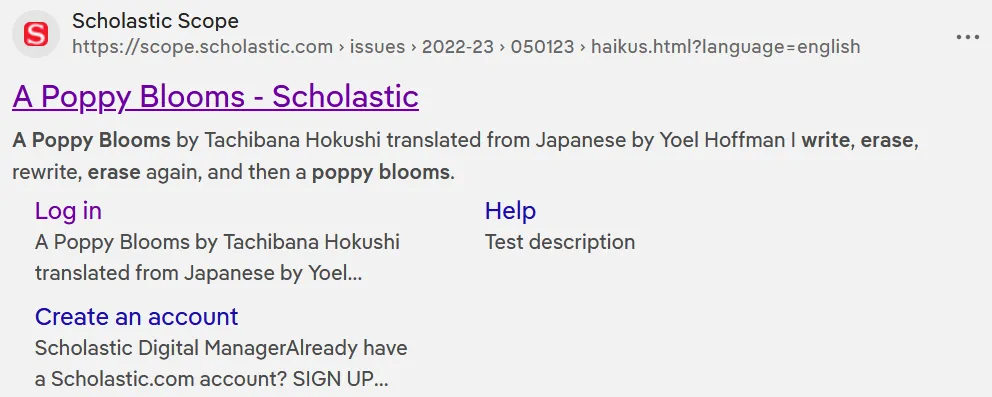
Finally! A translator credit! Let's just look inside and—

AAAAAAAAAAAAAAAAAAAAAAAAAA
It's okay. Thankfully the meta description was kind enough to tell me the name of the translator. My attempt to
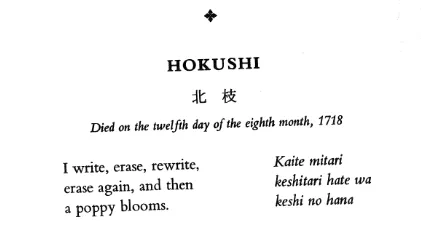
Finally! It was nice to have a normal academia timesink, as opposed to an inscrutable programming one, but I did spend maybe an hour on one tiny little citation. It's not like there's a moral, either; we already knew quite well that the new Internet is the sort of place where websites, bot or not, regurgitate the same trinket texts over and over without caring terribly where they come from. As a consolation prize, here's a fun fact:
Hokushi and his elder brother Bokudo, himself a poet, were famous for their ability to sleep while sitting and were accordingly styled "champion dozers."
Oh, my source? You're asking for my source for this fact? Why, it's Japanese death poems written by Zen monks and haiku poets on the verge of death by Yoel Hoffman, of course. Page 190.
God, that feels good to say.
A non-negligible amount of work, because I built my footnote-generating code from the ground up, and this was the one time I decided not to prematurely optimize!↩
It feels mean to link to this random person's blog. Instead, here is an essay from NaHaiWriMo that should explain why I think this is not only arrogant, but entirely misguided. (NaHaiWriMo's logo is the text "5-7-5", negated.)↩
You know the joke about the electrician who charges $1 to press the button and $99 to know what the right button to press is? That's how I felt finally trying
I write, erase, rewrite, erase again, and then a poppy blooms -hokusaiand getting the thing I wanted.↩As a last little wrinkle, he wrote a book called Curriculum Vitae, which didn't actually waste any of my time but it's funny that it could have, right?↩